Saturday, October 22, 2011

50/1001!!

It's cause for a little celebration! I have reached 50 books read from the list, boosting my confidence a smidgen to the possibility of actually completing all of the books at some point in my lifetime.

The fiftieth book was The Unbearable Lightness of Being by Milan Kundera. The novel fit in with the usual style in the interest of the person whom I received it (one such previous book received is most notably, Saturday) -- minimal plot pervaded by a stillness short of despair. Loneliness blanketed every aspect of Kundera's characters and my reaction was a pitied distaste at their incapabilities of being happy. It isn't that I needed them to be in fanciful relationships, I appreciate that there was turmoil in even the truest of "love", but I think mainly I just couldn't agree with most of the ways that the characters reasoned. Tereza, especially, did not appeal to me as I was incredibly turned off by her weakness. In Sabina I found the most connection and her hold on Franz as an idealic ghost resounded in me of its purity and beauty.
It was striking to me that the most emotional part of the story was represented by Tereza's love for a dog. I'm not quite sure how I feel about this...at first I was displeased by it because it seemed to me ill-fitting and reaching out to some sort of niche category of melodramatic (though powerful) stories about man's love for animals, but now I find value in the dog's role. He is, after all, the only character without any ugliness whatsoever. That is true to life.

For my next read, I was dead-set on reading Carl Sagan's "Contact", but having gone to both a used and new book store today (which, as a sidenote, reaffirmed my infinite love for bookstores which have the magical power to inflate me with the warmest of happiness) and was unable to find it, I think I am going to have to order it online. I didn't want to waste valuable reading time while I wait, however, so I bought Truman Capote's In Cold Blood. I see at least a few nights of being scared alone in my apartment coming on.

Sunday, October 9, 2011

#445

While I am still reading The Unbearable Lightness of Being, I was simultaneously enjoyingFranny and Zooey by J.D. Salinger over the past few days via internet. I chose it for its brevity, which I assumed would be more readily available for online viewing (especially since I am technologically inept and have a hard time finding anything for free. sad face).

I had been interested in the book for about a year because a favorite professor of mine had recommended it, but could not bring myself to buy it due to its thinness in comparison to many of th
e other books on the list. Therefore I am happy to have been able to find it online, especially as I did enjoy it and am glad to have been afforded a free fulfillment of entertainment in my time of dire need (I am at the poorest I have ever been in my entire life. The times are not lending themselves very well to the youth in terms of being able to claim these years as the best of our lives).

I think penning a boy named Zachary as Zooey to be quite charming and fitting of his East-Coastian academically high-brow nature. I did, however, have an erroneous pre-conception that the stories were about two girls, and therefore had to keep reminding myself that Zooey was the brother.

"Franny"-the first story-reminded me of Hemingway's Hills Like White Elephants in its style and tone, which I have a certain fondness for that I have no idea wherefore (perhaps for its ability to unsettle me? Anyway, I do love me a short story without a visible plot. I used to yearn to write in such a way as that story while I had short story classes in college, in the face of a teacher who adamantly preached otherwise). This first story actually had me missing university (mind you, not college, as I attended art school and not a real university), but in the sort of way that I was missing experiences that I never actually had. Strange, really, because I was feeling like I actually did have those memories. I do find it interesting though how vividly the story leaves an impression of pregnancy. I read a few criticisms of the work after I was through and they all shared that feeling with me, which I find queer.

I like both parts, but emotionally, "Zooey" was a bit more captivating. Stronger dialogue and deeper revelations. I think Salinger successfully illustrates familial love and personal uncertainties here, in the way of young people. Franny goes from being a sort of annoyingly juvenile young person, to a snotty well-to-do student, to a relatable young person contemplating her values. I encourage this read wholeheartedly.

Sunday, September 25, 2011

"It's pleasant sometimes to detain a holiday midnight for a while,"

said Woland.

I've finished The Master and Margarita (translation by Mirra Ginsburg), which proved itself to be one of the leisurely activities that I looked forward to during my downtime, as I have gotten a bit busier than I had been. Bulgakov's Satan is a rather charming and cultivated gentleman, who is more readable as human than any others of his sort I've ever come across. The reader becomes unassumingly attached to the evil group, and it is a wonder that though Woland and his crew's inner feelings are never mentioned, they carry more depth than any of the other sympathetic characters (though another part of it may be that I am terrible with names and had a hard time connecting with, let alone keeping straight the many long Russian names that were introduced).

I have to share, as it won my heart over ultimately, my favorite excerpt of the book;
"The tom, covered with dust and standing on his hind legs, was in the meantime bowing to Margarita. Now he had a white evening bow tie around his neck; a ladies' mother-of-pearl opera glass dangled from a ribbon on his chest. Besides, his whiskers were gilded
"What's this now?" cried Woland. "Why did you gild your whiskers? And why the devil do you need a tie if you have no trousers?"
"A cat isn't supposed to wear trousers, Messire," the tom answered with great dignity. "You will tell me to put on boots next!...But have you ever seen anyone at a ball without a tie? I don't intend to make myself a laughing stock and risk being kicked out!..."

A cat with gilded whiskers, imagine. How darling. And yes, I am a child for being amused so by that.

In short, the novel lives in the realm of the fantastic. I cannot say that I got all that I should have from it based on my frequent confusion, which renders this reading somewhat useless. I definitely need to go back and read it again in between some other readings to grasp its full merit, and so I will only really comment on its blatant surrealism, and my appreciation for its success in depicting an antagonist as both protagonist in the minds of the reader, as well as one that is emotionally favored.

It is also necessary for me to acknowledge my despair at the closing of Borders. Oh it is like my childhood love dissipating. Heartbreak. If it means a step toward the death of paper books it is a very sad thing indeed.

Next on the agenda, #256. The Unbearable Lightness of Being by Milan Kundera. Another book that was charitably given to me.

Sunday, July 31, 2011

Working my way through historical Europe

I must admit that after writing that last post, my appreciation for A Tale of Two Cities improved rather greatly. The novel ended on a much more personable attitude than I had perceived the rest of the book to be. It was not to the point that I should label this work to be the best of Dickens, but the climactic build was successful, and there was enough drama (and care in the reader) to cause for the typical cheers and heartbreaking for appropriate moments. How poetic for Miss. Pross to lose her hearing, and for Carton to die blissfully as the young couple whom he saved is innocent in their oblivion.
My copy of this book was afterworded by Stephen Koch. I did not much agree with his points (he stressed sexuality and rape to a point which I found annoying especially). I know that one must speak with boldness and confidence in writing such a thing, but his tone somehow seemed arrogant and absurd. Mr. Koch claims that the modern reader cannot appreciate Lucie in the way that she was intended -- I do not agree with this at all. A reader, in this day, who is literate enough to grasp the madonnas of yesteryear are educated enough, I think, to understand exactly what she is; her naivety and virtue are not borne of simplicity, but as a physical imagining of purity. Obviously. And I think that it was a strength of Dickens', with just a small glimmer, to introduce the young girl at the gallows to have just as much if not more courageous strength in purity and character/emotion than the heroine. I am, however, a big fan of the name "Lucie". How precious and cute in its spelling.

Anyway, speaking of supporting literature, I have also just finished Fyodor Dostoevsky's Notes from Underground (translated by Richard Pevear and Larissa Volokhonsky), which was given to me from the beau as a birthday gift. This translator duo is amazing. Unlike my experience with Koch's writing, I hung on to almost every word in the foreward for Notes with a wonder similar to what I feel for the foreward in Hawthorne's Scarlet Letter. Translation is an art, as I've come to learn, and Pevear and Volokhonsky do it with finesse and respect. They explain their strenuously particular word choice in comparison to other translations, and this is a dire importance. The folks know what they're doing, and it is appreciated so that I as the reader can get the full value and meaning of the work (or as close to it as possible) without learning another language -- though I'd love to. They write beautifully themselves, aside from this as well; "In fact, we do not really see [the author], we only hear him, and not through anything so respectable as a window, but through a crack in the floorboards". Superb.

The book itself, is the isolated melancholy of a solitary man typical of Dostoevsky. His self-inflicted torture is hard to read at times, with little sympathy being afforded to the speaker. A ray of possibility of escape from this is brought with Liza (whom I cannot help but to imagine as Marion Cotillard, though I know that it's inaccurate), but she too is quickly gotten rid of, disappointingly, and the work ends somewhat abruptly...but also fitting of the hopelessness of the character. I appreciate the simplicity of this work -- the narration seems honest, and makes me wonder about Dotoevsky's own mentality, though it seems that these pessimistic tones are more reflective of the people who interested him rather than he himself. Taking Notes more as a train of thought than as a story, I enjoyed it as something between a character study and a release of thought/ideas and point of view.

Next up is another Russian novelist (also a part of the birthday gift previously mentioned): The Master and Margarita by Mikhail Bulgakov. My Lithuanian boyfriend seems to favor the eastern european regions.

Wednesday, July 20, 2011

The past few months

I regret to confess that I have been holding off on updating my progress of the List -- mostly from laziness -- for the past month and a half, with no excuses.

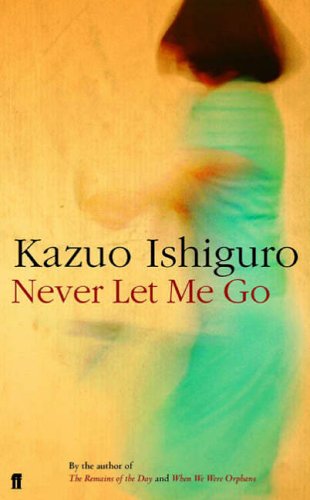
In fact, I finished "Never Let Me Go" quite a while ago, and very quickly, and was putting off writing about it until I had finished my current endeavor of "A Tale of Two Cities" because of the speed with which I had read through it. This obviously proved to be a mistake, as the latter has been a laborious read for me that seems never-ending.

I will have to apologize for my glossed over account of this novel, as I have most likely forgotten any slightly-profound input I could have acquired during my reading it. Anyway, I was excited to read "Never", as I am very limited in my Japanese literature (if it can be lumped there, since he is technically a British author), and have heard such great things. I will have to say though, that I was disappointed, and not too taken with Ishiguro's novel. I found it rather dull and incredibly predictable. I am not the biggest fan of romantic literature, but I had begun the work thinking that it would outdo that genre. The characters seemed too juvenile, despite the plot of their sheltered lives, and I honestly felt no deep emotion for the characters whatsoever. There were a number of scenes with potential of being powerful, I think, but Ishiguro did not build and end them in the way I would have liked, rather letting them fizzle out. For example, Tommy's drawings seemed interesting, but were handled very immaturely, as the subject was illustrated without the intricacies that the drawings were supposed to hold. Interest in the artwork, that was supposed to be beautiful, was quickly lost. The same goes for Ruth's encounter with her "possible".
The adults were the most intriguing part of the novel, and I enjoyed the memory moments that introduced them, and shed light on fragments of their tormented psyche -- perhaps Ishiguro's talents lie in writing in the adult person, and not as an adolescent's. I think that I rather liked the ending for its simplicity, but again, I really don't even remember, so that must prove how forgettable this read was for me (even despite my poor memory).

And as for "A Tale of Two Cities"; I am not at all experiencing the favor I had for Dickens' "Great Expectations" in this work. I feel like I've been reading this for so long and still I am not done. In fact, I often fall asleep to it (though I do not think it is worthy of labeling this title as a snooze-fest, it is just something that ends up happening). I admit, this novel is much more mature and sophisticated than "Great Expectations", but what I yearn for in a book is depth in personality and character development, not edge. I cannot deny the power behind Dickens' writing -- his mastery of drama is artfully elegant, and he blends historical references and feelings with narrative rather well, but it just doesn't seem enough to keep me ultimately engaged. Perhaps my opinion will change when I actually finish. Only 43 pages to go.

Wednesday, June 1, 2011

Wishing for someone to endow me with great sums of money

Damn me for not aiding convicts in graveyards at a young age. What was I doing instead? Playing with stuffed animals? Mistake. Maybe then I would have been rich by now. Not to mention, a respectable lady.

I enjoyed Great Expectations very much, and thought it rather darkly compelling in a sunlit way (if that is to be taken with the mindset that I am a fan of American gothic) with the misshapen faces in Jaggers' office (as well as Jaggers himself, and Ms. Havisham too) serving as the centerpoint for such moods.

I really honestly like most of the characters in this story. Favorite = Wemmick. Runner up = Herbert. Obviously. These characters are so fleshed out and amiable that one cannot help but to love them dearly. The working up to Wopsle's wedding was basically the cutest thing to ever happen (Halloa!).
Pumblechook, I disliked immensely, in not a hateful way, but more of an annoyance in a way that in the moments where he was introduced into the text, I was hurriedly reading waiting for him to take leave. He is like that annoying fly buzzing around your head that you want to ignore but simultaneously irritates you to the point of outrage until you cannot leave it alone (and must act out on, as Pip does). Estella, too, I could not grow to like as she was a very flat character, dismissible herself -- in just the way that she could not take to any man, I found no fondness for her.

I was not pleased with the ending, which seemed faded and like an afterthought. The version I was reading held Dickens' original ending without a marriage, and though I understand that the latter was frowned upon, I would have to say that the original is not much better. To spoil such a wonderful novel as the rest of it proved to be with such a quick end was a discredit, I think, mostly because Dickens' ability to end romantically was prevalent in other chapters: "At about six o'clock of the morning therefore, I leaned over her and touched her lips with mine, just as they said, not stopping for being touched, 'Take the pencil and write under my name, 'I forgive her.'" (Chapter XLIX), as well as the chapter containing Provis' death.

Speaking of romanticism, I finally cracked open J.S. Foer's very expensive paperback. Fragile to read, as the pages were often tangled upon themselves, but interesting to look at. The narration was poetic in a way that Foer is a master at, but the afterword, to me, was the more compelling. This man is a sensitive genius, I swear it, and I love everything he has to say through prose. His soul is beautiful, and he makes being Jewish a profoundly poetic thing. And he should rightly be very proud.

Thursday, May 5, 2011

From Killick-Claw to London


Finished Annie Proulx's The Shipping News (#133) yesterday. I really enjoyed this one; duly deserving of all its pomp and fanfare of awards and titles. What a pleasant read: subtle plot, complex and realistically human emotions, a fine balance of fantasy and reality, and thoughtful humor. Quoyle, the protagonist, is simultaneously tragically pitiful and yet endearing and surprisingly lovable (the fact that he is such a good father melts the heart), and there is a tenderness in Bunny that is very maturely drawn.

This is a book that makes me glad for text - I would not ever want to see this novel in its movie form. I can picture Quoyle and Wavey, but harbor not an ounce of desire to see them as a real-life entity represented by actors. They are like beautiful dreams or paintings in my head, sharp yet blurred at the same time in a complex way that I wish to remain so.

I have great respect for Proulx. Her imagery (and therefore, her imagination) is so vibrantly fresh and unconventional. Take this example, in Chapter 7 (The Gammy Bird); "...the wall behind him covered with oilcloth the color of insect wings. His face: wood engraved with fanned lines...Bushy eyebrows, a roach of hair the color of an antique watch". The book's end, is my favorite. How gracefully she managed it: "For if Jack Buggit could escape from the pickle jar, if a bird with a broken neck could fly away, what else might be possible? Water may be older than light...it may happen that a crab is caught with the shadow of a hand on its back, that the wind be imprisoned in a bit of knotted string. And it may be that love sometimes occurs without pain or misery".


So on my see-saw between eras, I now return back to the 1800s, with Dickens' Great Expectations. I am hoping that The Shipping News has started a trend, tunneling out of the darker, more pessimistically mooded stories, but considering the context of this book centering around an orphan, I am not exactly confident that it will be so. I should, also, probably know more about classics such as these already, but I will throw in the towel and acknowledge that I am a complete n00b to many literary classics. But hey, that's what I'm working on, by reading through this list, right?