It's unfair to say that I gave Mr. Palahniuk a fair chance, having gone into this with a preset distaste for his writing. But honestly, he could have proved me wrong, delivering something substantial and interesting...albeit the "edgy" tone which is so common to him, and which I dislike (though can appreciate through my prejudice in other writers).
Palahniuk is compared to Vonnegut? I don't know about that. I rather think that he is a cliché and that he tries too hard to be crude in order to be cool - which, he doesn't accomplish well. Sex, grit, and insanity? Typical. Try to be a little more creative, please. First chapter was so overdone it was painful; calling the main character as an innocent child an array of bastardizing and profane adjectives is not new, interesting, or funny - it's just sad, because there is less respect that I can give C.P. for what he's doing. It isn't style, it's just a lack of talent in being able to make a weighted plot. I didn't give two shits about a single one of the characters in this book - and not in the way that the author would have liked. This only means that he doesn't know how to sculpt a character...to make them three dimensional, and actually human. And the excessive use of lists is just plain annoying. I was constantly begging for the last page to come.
It may not have been a wise decision, on my part, to be simultaneously reading two books about psychotic mothers either (not that I planned it this way), as I am now more than halfway through The Memory Palace. But that may be the problem in my aversion to these books; I don't like either, which is making my dissatisfaction at the both of them much greater than had I taken either of them alone.
Bartok's book isn't bad. In fact, her interests in topic and style are very similar to mine. What's bothersome, is the self-pity. On top of that, is the TERRIBLE editing, which I can't forgive. The spelling errors/typos are too numerous to go unnoticed (and although it is her first novel, it is not her first book). And on top of that, I don't like her art, which she has managed to not-so-nonchalantly scatter throughout the work. I envy her life (minus the schizophrenic mother): teaching at the Field Museum, going to Europe, becoming a somewhat successful artist, etc etc. She went to SAIC like me, and managed to do things that I only dream of doing (how the hell did she even get these gigs, I would like to know) and yet her art is not that good. Why!? Tell me, what the hell is it that my friends and I, post grad, are all doing wrong that this person can be as successful as she is? If it is just that she is exploiting her rough family life, then she will have to leave that heartache she's sparing for herself in due to her mother behind, as there are plenty of us with happy pasts who are struggling. The balance seems at this point, somewhat leveled. This all just comes down to bottom line, SOMEONE HIRE ME.
Not quite sure yet which book is next to continue on with the list, but it will be interesting to see where my mind will wander next in course of whatever it may be.
Tuesday, April 12, 2011

Monday, April 4, 2011
Having Been to the Galleys and Back
At an almost completely four month stint of living alongside Jean Valjean/M. Fauchlevant/M. Madeleine/etc etc, I have finally reached the end of the road. It was a very tragic and divine parting of ways, with the final scene depicted in the vein of a Chiaroscuro painting.
Hugo's characters are incredibly black and white. It is easy to hate the coal-hearted villains, but it was much more difficult for me to swallow the naivety and carelessness of the innocent (especially in Cosette, after her marriage - so Audrey Hepburn of her to be so blinded by love as to throw all other, more crushingly important and urgent matters out of mind). Even so, you cannot help but to love and admire them, and in the end, it is all resolved in the most pleasant of ways anyway, which is good, as I would not have liked to have ended a novel such as this on some kind of open ended or doomed situation, as modern writing may encourage. I don't mind that the characters are ideals, or that they are sometimes two-dimensional. I love Jean Valjean for his innate goodness, Fantine for her will, and Cosette for her innocence (Marius, on the other hand, was rather forgettable and lackluster...he is good, but his purity is unconvincingly adolescent).
The book for me was a welcome cliche of an escape. For moments at a time, I was not on the el on the way to a dead-end job at the Marriott, nor was I pondering all of the failures in my current state of affairs. It was, possibly for the first time (at least, in terms of causing me to think about it as it happened), that experience that people always describe reading as; an experience removed from reality, allowing me access to not so much actions and setting, but direct, weighted emotions that tied my real anxieties and happinesses in some kind of moving, full-circle way. To intermittently be Jean Valjean for four months was somewhat of a blessing, at this point in my life.
 And now, time for me to make my way onward as other literary hero(in)es. Seeing as I have some sort of pattern going with classics, to (more) modern, and so forth, I will come back to an era closer to today. One of my best friends gifted to me numero quarante-huit, Choke by Chuck Palahniuk this past December (which, I am grateful for, as I do not have favorable ideas of him, and therefore would not have been happy to purchase the book myself), so I figure now is as good a time as any to test my thoughts on this author. Can I just say that Lullaby was atrocious, and almost unreadable? Disgusted. Still, I will give him another shot, as I have heard some good things about Choke (whether or not I trust their literary merit is up for grabs). I am expecting this read to go extremely quickly, by standards of his writing style.
On a side note, I have recently also acquired (among other books on the list, which will not be named until it is their turn to be read) The Memory Palace by Mira Bartok based off of an interesting review I read in some women's magazine I fail to remember now, as well as Jonathan Safran Foer (LOOOOVE!!!)'s Tree of Codes, a rendering/artistic take on Bruno Schulz's Street of Crocodiles (which I also intend on reading, once I can get my hands on it). I must confess I spent an absurd amount of money on the Safran Foer book, as it is a first edition, and am still hesitant to unwrap its original wrapping as if it were something holy. I will be making time to read these in between 1001 list projects.
Hugo's characters are incredibly black and white. It is easy to hate the coal-hearted villains, but it was much more difficult for me to swallow the naivety and carelessness of the innocent (especially in Cosette, after her marriage - so Audrey Hepburn of her to be so blinded by love as to throw all other, more crushingly important and urgent matters out of mind). Even so, you cannot help but to love and admire them, and in the end, it is all resolved in the most pleasant of ways anyway, which is good, as I would not have liked to have ended a novel such as this on some kind of open ended or doomed situation, as modern writing may encourage. I don't mind that the characters are ideals, or that they are sometimes two-dimensional. I love Jean Valjean for his innate goodness, Fantine for her will, and Cosette for her innocence (Marius, on the other hand, was rather forgettable and lackluster...he is good, but his purity is unconvincingly adolescent).
The book for me was a welcome cliche of an escape. For moments at a time, I was not on the el on the way to a dead-end job at the Marriott, nor was I pondering all of the failures in my current state of affairs. It was, possibly for the first time (at least, in terms of causing me to think about it as it happened), that experience that people always describe reading as; an experience removed from reality, allowing me access to not so much actions and setting, but direct, weighted emotions that tied my real anxieties and happinesses in some kind of moving, full-circle way. To intermittently be Jean Valjean for four months was somewhat of a blessing, at this point in my life.
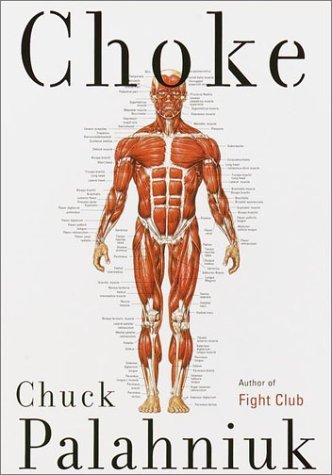 And now, time for me to make my way onward as other literary hero(in)es. Seeing as I have some sort of pattern going with classics, to (more) modern, and so forth, I will come back to an era closer to today. One of my best friends gifted to me numero quarante-huit, Choke by Chuck Palahniuk this past December (which, I am grateful for, as I do not have favorable ideas of him, and therefore would not have been happy to purchase the book myself), so I figure now is as good a time as any to test my thoughts on this author. Can I just say that Lullaby was atrocious, and almost unreadable? Disgusted. Still, I will give him another shot, as I have heard some good things about Choke (whether or not I trust their literary merit is up for grabs). I am expecting this read to go extremely quickly, by standards of his writing style.
On a side note, I have recently also acquired (among other books on the list, which will not be named until it is their turn to be read) The Memory Palace by Mira Bartok based off of an interesting review I read in some women's magazine I fail to remember now, as well as Jonathan Safran Foer (LOOOOVE!!!)'s Tree of Codes, a rendering/artistic take on Bruno Schulz's Street of Crocodiles (which I also intend on reading, once I can get my hands on it). I must confess I spent an absurd amount of money on the Safran Foer book, as it is a first edition, and am still hesitant to unwrap its original wrapping as if it were something holy. I will be making time to read these in between 1001 list projects.
Thursday, January 6, 2011

Tuesday, January 4, 2011
Chance Happenings and the Moon
Finished Moon Palace just now. Definitely my favorite of the lot, so far; I'm fond of the preposterousness of chance happenings worked through the plot, with its obvious scatterings of motif a la lune. And a cliffhanger ending too? Come on, cheese factor off the charts, but I'm eating it up.
On a side note, since we all know my obsession with Nathaniel Hawthorne, at one point in the novel (page 144 in this copy to be exact), a minor, untalented writer character is mentioned as the son of the Great. Brownie points for a good shout out with bad irony.
And then on page 122, a few things I had highlighted, as they seemed profound at the time of reading:
"The world enters us through our eyes, but we cannot make sense of it until it descends into our mouths".
and
"More to the point, the same brick was never really the same".
How philosophically artistic.
Finally, the book ends in a full moon behind Fogg. Can I just say that tomorrow is the full moon? At least, according to my new 2011 calendar.
On to further business, I have acquired a handful of new books (thanks to Christmas, and other CHANCE happenings that dropped Les Mis into my fateful hands) from the List to progress my reading for at least another couple months. I will be well-read in no time.
On a side note, since we all know my obsession with Nathaniel Hawthorne, at one point in the novel (page 144 in this copy to be exact), a minor, untalented writer character is mentioned as the son of the Great. Brownie points for a good shout out with bad irony.
And then on page 122, a few things I had highlighted, as they seemed profound at the time of reading:
"The world enters us through our eyes, but we cannot make sense of it until it descends into our mouths".
and
"More to the point, the same brick was never really the same".
How philosophically artistic.
Finally, the book ends in a full moon behind Fogg. Can I just say that tomorrow is the full moon? At least, according to my new 2011 calendar.

On to further business, I have acquired a handful of new books (thanks to Christmas, and other CHANCE happenings that dropped Les Mis into my fateful hands) from the List to progress my reading for at least another couple months. I will be well-read in no time.
Tuesday, December 7, 2010
Parallels between Minami Furukawa and Marco Stanley Fogg:
- Both somewhere around the age of twenty-something, living in a studio apartment.
- Marco is living off of two eggs a day. The contents of my refrigerator right now: three eggs, a half packet of mozzarella cheese, three half bags of frozen vegetables, juice, milk, a six pack of holiday ale, and various condiments (useless, as I have nothing to use them on). My cupboard is not any more impressive; two packets of ramen noodles, half a loaf of bread, a can of creamed corn. I do however, have a bowl full of fruit which I have been sustaining myself on when I have to eat at home (I fortunately get fed at work every shift, so that limits the amount of grocery shopping I need to do).
- Marco’s uncle was a traveling musician playing clarinet. I played clarinet for eight years, having to give it up for art school.
- (page 41, chapter 1) “I had lost the ability to think ahead, and no matter how hard I tried to imagine the future, I could not see it…the only future that had ever belonged to me was the present I was living in now, and the struggle to remain in that present had gradually overwhelmed the rest…if life was a story…and each man was the author of his own story, then I was making it up as I went along…the question was what I was supposed to do when the pen ran out of ink”.
- Marco is not an artist, but drawing back on Gordon Comstock, I am creating for no reason but to keep the habit. However, in vein of both he and Marco, I am in a bit of a financial decline to the point that I have had to rule out buying Christmas presents for the parents (and I am on a budget for the besties). In consolation, I have decided to give them a painting in the usual purchases’ place.
Here are some of the things I have been working on for the past month+, just for kicks.


(Though I am nothing even close to anything resembling a true painter, that giant dark blob on the left was exhilarating to paint, and it brought me closer to understanding artists like DeKooning, whom I have hated for years).
Let's hope I don't end up living in Lincoln Park like Marco does (though in the much more impressive Central Park), or if it comes to that, that my friends bail me out before it happens (I like to believe I have a few Zimmers and Kittys--Fogg's support group--in my life).
Thursday, November 25, 2010
Gordon Comstock, you little bitch
Orwell's Aspidistra was a quick read, fairly easy and entertaining enough, though drawing too completely on exaggerated typecasts of generic classes (though I guess that was to be expected). "Struggling" lead character (I refuse to define him as protagonist...and now that I consider it, antagonist would be a much more fitting title) Comstock is irritatingly self deprecating and how such a person could continue to maintain the support and love of friends and family is beyond me. The character houses pride over having no pride -- it's supposed to be ironic, I know -- but Orwell's style of overly obvious irony does not work here. It is to my understanding that many parts of this novel were inspired by Orwell's own life, and I do appreciate that, but one knows a story needs much more than that to draw the attention of the reader.
Love interest Rosemary, however, is genuinely likable and made the read bearable. She is of course too good for Comstock, but that is always the trend in couples in entertainment is it not?
As for the mystery of the flying house plant, I am still in the dark. Mention of the aspidistra was brought up at least five times per chapter, but I see no importance in the choice to use this particular plant to illustrate the contrast between this thriving, sturdy thing versus the fragile and sorry Comstock. Personally, I find the use of the aspidistra as a tool for symbolism a weak one. In all honesty, when I pictured anything to do with keeping an aspidistra "flying", all I could imagine was shit hitting a fan. I know, I know, not even close to the point.
In the end though, I am not denouncing this book. It was not terrible, nor was it exceptional, and it is interesting to consider it as something still in (leading to?) the vein of Animal Farm.
I did especially enjoy this passage where the failing poet looks back on his writing project, as I found it genuine and accurate of anyone devoting themselves to such a task; "There it was, sole product of two years--of a thousand hours' work, it might be. He had no feeling for it any longer as a poem. The whole concept of poetry was meaningless to him now".
It is exactly the way I had been feeling about my thesis when I was graduating college. My thesis was comprised of a collection of vignette poems, imagery, and objects, and having worked on it for months and thinking of little else, the product seized to become poetry, or even as artwork, but rather a queer sort of assignment with a sterilized meaning. One's perception of their own creative endeavors become skewed so easily after being pored over for so long. I like to imagine that Orwell was feeling this way himself as he was writing, which is easy to assume.
 So after all of that, the next book up is #188; Moon Palace by Paul Aster. I'm quite excited, starting a new book is probably the best part about reading, at least to me. The title too, sounds quite promising to me as it sounds quite lovely-nice in a calm manner. It is about an orphan and the previous generations in his family. It is also, apparently, a resort in Cancun. We shall see, we shall see.
Borders on Michigan Avenue is having a Going-Out-Of-Business sale with lots of price-slashing. I always think to go in there to get as many books as possible which I have remaining on the list but it never happens, and I am sure I will run out of time soon. I should learn from Orwell's character and just get on with it.
Love interest Rosemary, however, is genuinely likable and made the read bearable. She is of course too good for Comstock, but that is always the trend in couples in entertainment is it not?
As for the mystery of the flying house plant, I am still in the dark. Mention of the aspidistra was brought up at least five times per chapter, but I see no importance in the choice to use this particular plant to illustrate the contrast between this thriving, sturdy thing versus the fragile and sorry Comstock. Personally, I find the use of the aspidistra as a tool for symbolism a weak one. In all honesty, when I pictured anything to do with keeping an aspidistra "flying", all I could imagine was shit hitting a fan. I know, I know, not even close to the point.
In the end though, I am not denouncing this book. It was not terrible, nor was it exceptional, and it is interesting to consider it as something still in (leading to?) the vein of Animal Farm.
I did especially enjoy this passage where the failing poet looks back on his writing project, as I found it genuine and accurate of anyone devoting themselves to such a task; "There it was, sole product of two years--of a thousand hours' work, it might be. He had no feeling for it any longer as a poem. The whole concept of poetry was meaningless to him now".
It is exactly the way I had been feeling about my thesis when I was graduating college. My thesis was comprised of a collection of vignette poems, imagery, and objects, and having worked on it for months and thinking of little else, the product seized to become poetry, or even as artwork, but rather a queer sort of assignment with a sterilized meaning. One's perception of their own creative endeavors become skewed so easily after being pored over for so long. I like to imagine that Orwell was feeling this way himself as he was writing, which is easy to assume.
 So after all of that, the next book up is #188; Moon Palace by Paul Aster. I'm quite excited, starting a new book is probably the best part about reading, at least to me. The title too, sounds quite promising to me as it sounds quite lovely-nice in a calm manner. It is about an orphan and the previous generations in his family. It is also, apparently, a resort in Cancun. We shall see, we shall see.
Borders on Michigan Avenue is having a Going-Out-Of-Business sale with lots of price-slashing. I always think to go in there to get as many books as possible which I have remaining on the list but it never happens, and I am sure I will run out of time soon. I should learn from Orwell's character and just get on with it.
Sunday, October 31, 2010
FINALLY.
After two full months, I am finally finished with Don Quixote. In that time, my aged, hand-sized copy's cover has torn in two, been mask taped, and then finally just fell off altogether. Somewhere between there, the video bonus question on Cash Cab asked a question about La Mancha, and I was delighted.
But on to my past month with Don. Fabulous, actually. Part II is so much stronger than the first, I think, which is quite an accomplishment for most writers. Cervantes is cheeky, and self-conscious, playing jest and never taking itself seriously.
Sancho's character wins over much more admiration as well, showing surprising intellect at times, and basically just winning me over altogether. If I ever get a pet, I will name him Sancho. Don Q too is obviously an intelligent character, but Sancho is his backbone that drives the reader to go on, as without him he is just a creepy, crazy skinny old man (when he is in his madness, at least) wandering through medieval Spain.
In the end, "...if he like a Madman liv'd/At least he like a Wise One dy'd", as DQ's epitaph states. He does, actually, show his wisdom and sanity in the last pages, but it is abrupt and strange. I don't mind, and I appreciate the shortness/directness of the way it wrapped up, actually.
So on to the bookshelf this classic goes, with the rest that will follow.
I am sitting here listening to Radiolab, sentimentally looking back on August, when I started reading Quixote. It was warm out, and I was less tired. Oh the weight of the world. Which brings me to the next book, which should be a much much faster read. George Orwell's Keep the Aspidistra Flying. As the back of the book says, "A poignant and ultimately hopeful look at class and society, [the book] pays tribute to the stubborn virtues of ordinary people who keep the aspidistra flying".
What is an aspidistra? I have no clue. So here is the definition by the Merrian Webster: Any of several eastern Asian plants of the genus Aspidistra in the lily family, especially A. elatior, which has large evergreen basal leaves and small, brownish bell-shaped flowers and is widely cultivated as a houseplant. Also called cast-iron plant.
Why does it fly? Beats me. Maybe I will find out. Anyway, ladies and gents, here we go, onwards to #620.
But on to my past month with Don. Fabulous, actually. Part II is so much stronger than the first, I think, which is quite an accomplishment for most writers. Cervantes is cheeky, and self-conscious, playing jest and never taking itself seriously.
Sancho's character wins over much more admiration as well, showing surprising intellect at times, and basically just winning me over altogether. If I ever get a pet, I will name him Sancho. Don Q too is obviously an intelligent character, but Sancho is his backbone that drives the reader to go on, as without him he is just a creepy, crazy skinny old man (when he is in his madness, at least) wandering through medieval Spain.
In the end, "...if he like a Madman liv'd/At least he like a Wise One dy'd", as DQ's epitaph states. He does, actually, show his wisdom and sanity in the last pages, but it is abrupt and strange. I don't mind, and I appreciate the shortness/directness of the way it wrapped up, actually.
So on to the bookshelf this classic goes, with the rest that will follow.
I
 am sitting here listening to Radiolab, sentimentally looking back on August, when I started reading Quixote. It was warm out, and I was less tired. Oh the weight of the world. Which brings me to the next book, which should be a much much faster read. George Orwell's Keep the Aspidistra Flying. As the back of the book says, "A poignant and ultimately hopeful look at class and society, [the book] pays tribute to the stubborn virtues of ordinary people who keep the aspidistra flying".
What is an aspidistra? I have no clue. So here is the definition by the Merrian Webster: Any of several eastern Asian plants of the genus Aspidistra in the lily family, especially A. elatior, which has large evergreen basal leaves and small, brownish bell-shaped flowers and is widely cultivated as a houseplant. Also called cast-iron plant.
Why does it fly? Beats me. Maybe I will find out. Anyway, ladies and gents, here we go, onwards to #620.
Subscribe to:
Posts (Atom)