Monday, July 7, 2014

A Portrait of the Artist as a Young Man

I think I can confidently say now that Irish literature bores the life out of me.  If I wanted to read about Jesus and hellfire, I would have opened the bible.  Is this book telling us that all artists live without God?  Perhaps that is somewhat true, but that is the way I prefer it.

My life as a dabbler in art never consisted of religion.  I was surrounded by it, and was even directly exposed to it at times, but it was from the start an extremely foreign and ridiculous notion.  Why live your entire life in fear of some story that ends in punishment, simply because you wanted to experience pleasure while you're friggin' alive?  What the hell kind of spiteful creator is that?  The whole notion makes me uncomfortable and rather angry.

Even though Dedalus chose art in the end and he is basically agreeing with me, it bothers me that he was so devout to begin with.  I AM SO GLAD THIS READ IS OVER.

I guess there was never any other path for me than to be drawn to art.

Sunday, June 29, 2014

The Long Dark Tea-Time of the Soul

There are a lot of unanswered, nonsensical components to these books that I find rather confusing simply because Mr. Adams is clearly a rather clever man who does not seem likely to be careless about the details of his plots.  Why did the eagle show his wings to Gently?  How did the refrigerator god come to be?  Is it all only for a desire to have quirkiness?

As I got to the final chapters of this book, I started getting more and more fearful that I would not receive a decent ending with satisfying a-ha's and revealing wrap-ups, and I was somewhat correct in this dread.  I accepted it in the first of this series because I thought of it as a story to be continued, but the same approach was taken in Tea-Time, where the ending felt rushed and overly simple.  For all of the work put in to previous chapters to create a very successful build-up with strong characters, it's surprising to find the close in both cases to be rather puny.  It seems a bit like the characters I've come to like so much have been denied something they so very much deserve.

Nevertheless, I still like these books.  I find Adam's writing style very enjoyable (his personification of objects is delightfully adorable), and his characters to be quite genuine (as by now you obviously know).  I'd like to see more of Dirk Gently if I could.

Tuesday, June 24, 2014

Dirk Gently's Holistic Detective Agency

Charmingly British...or Britishly charming...through and through.  Douglas Adams' writing, per usual, is expertly playful with lots of wit and clumsily likeable characters.  His simple writing style contrasts a somewhat intricate plotline that twists and turns to keep your mind alert.  In simple terms, this book is the Monty Python of novels, with a bit of The Third Policeman thrown in.  Ghosts!  TIme travel!  Horses!  Poets!  Recommend!

And now onward to the second part, The Long Dark Tea-Time of the Soul.

Friday, May 23, 2014

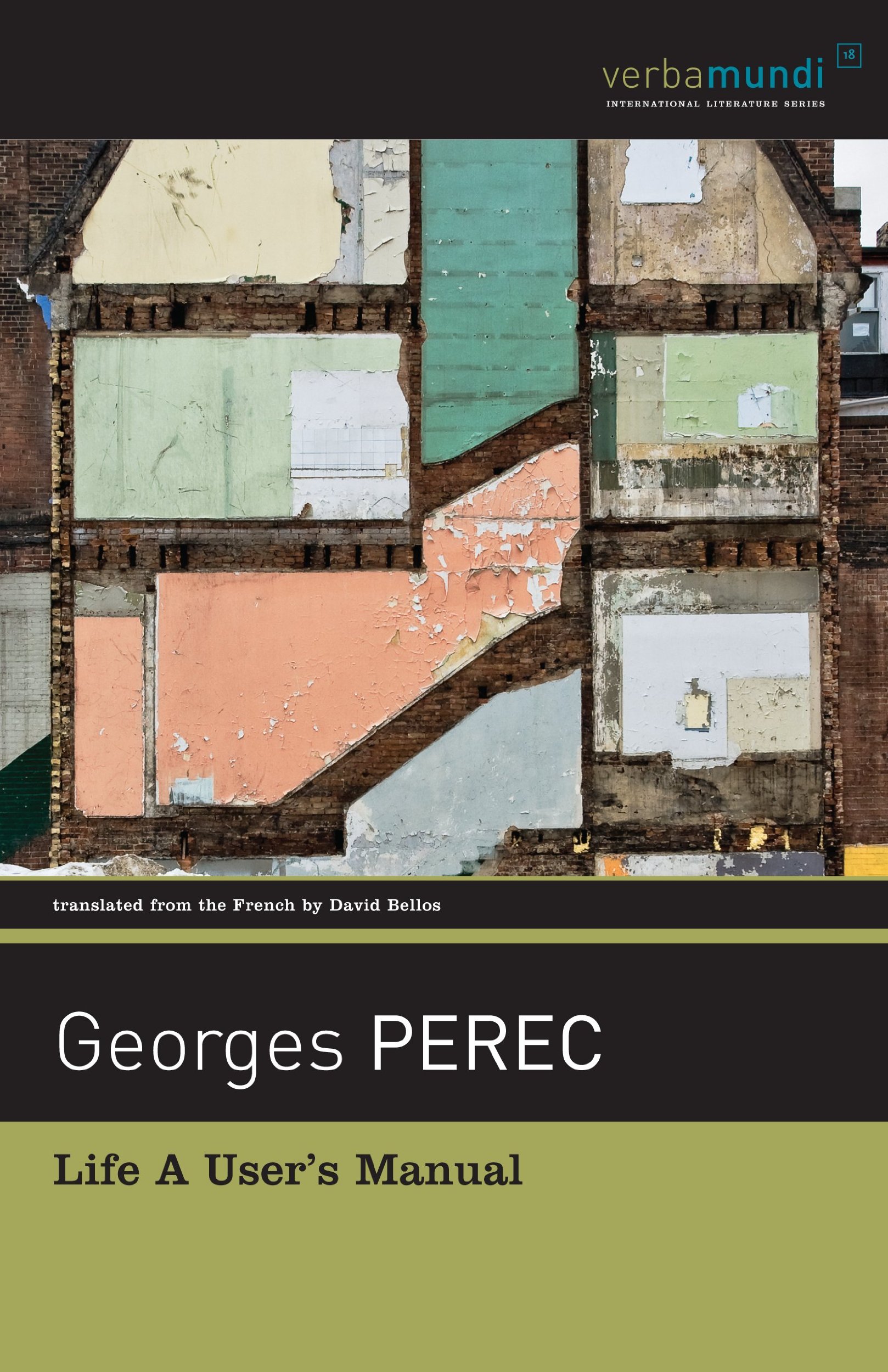
Life: A User's Manual

Georges Perec's  Life: A User's Manual is a wonder.  His 99 chapters are brief little vignettes into the moments of various tenants' lives inside an apartment complex at 11 Rue Simon-Crubellier, written with incredibly minute care.  In the very same way, every piece of artwork in each of these scenes (every single chapter as far as I can remember contained at least one piece of art) is described, melding action and physical atmosphere into uniform thoughts in a way that I've never seen done before.  I honestly cannot describe this with success and reading what I have just written only fills me with annoyance as it is not doing what I'd like.

The main component that everything (plot, narrative, structure) in this book revolves around is the puzzle, but I am happy to say that it is not in the obvious sense of puzzle-as-mystery with the conclusion being a big reveal.  This book ends quietly but with accomplish and care, owing hours of work leading to the finish.  It is an experience, both visually and strategically.  While reading it, I often thought of it as every story that a writer would like to write, compiled into one, and because of this, it never leaves the reader bored (adventure, romance, history, emotion, it's got it all).

I have been on the cusp of finishing this brick of a book for about 2 weeks now and have finally made it, with the same relief that Bartlebooth must have felt upon completion of his puzzles.  I will, no doubt, reach for another challenge immediately afterwards as he did, though with this trace of proof left behind instead of the artist's habit of erasure.

Sunday, February 23, 2014

Glamorama

#87. Glamorama by Bret Easton Ellis.

What in the flying fuck?  I'm pretty sure it's safe to say that i never ever want to be left in a room alone with Bret Easton Ellis.  He is probably one of those people that gets really close while he's talking to you and as you inch away he just keeps getting closer and maybe touches you on the arm as you start to panic about how fucking creepy he is and how he just might rape you.  Also, the intensity of his loathing toward rich people is a little annoying.

The book started off painfully slowly, taking probably more than 1/3 of the whole 546 pages to pretty much just rattle off a bunch of celebrity names and designer brands.  I know I know, this is supposed to be effective satire about consumerism and money and blah blah but I'm pretty sure that could be done much quicker than Ellis felt necessary.  On top of that, the complicated "set-up" type story, nor the whole concept of real life vs. film production is never effectively explained and it just seems like a vague idea that Ellis never cared to tighten.  He was probably too busy finding more celebrity names to mention.

Ellis is as showy as Andy Warhol, without the talent.  At least the artist's aesthetic had intent and cultivated style.  Maybe then, he is more like Koons, who pretty much everyone that went to art school looks down upon.  I bet you his favorite word is juxtaposition.

I tried to get an explanation for what I obviously must have been missing, but anyone who gave this book praise didn't really have any reasoning and just said that it changed their lives...which is funny, because it just makes them sound like posers, which this book is supposed to be speaking out against.
Anyway, this review does much better than I could do, so pretty much just read this instead of getting the very little information that I can provide: http://www.nytimes.com/books/99/01/24/reviews/990124.24mendelt.html

"I can't imagine that anyone actually enjoys these torturous novels -- except, perhaps, the people whom the books clandestinely celebrate, the actor-models and model-writers and celebrity-editors and their gang. But then, Ellis has become a sort of hip brand-name label in the publishing world, and people go in for him precisely for the reasons they might go in for a $300 Helmut Lang plain cotton shirt: It's so outrageous they assume there has to be something to it. But there isn't. The emperor has no clothes, designer or otherwise."

I couldn't (obviously) have said it better myself, NYTimes.

Sunday, January 5, 2014

Nights at the Circus & Fear and Trembling

I bought a handful of books on Amazon a few months back, and received a variety of products ranging from somewhat tattered used hardcovers, to good as new paperbacks.  My copy of Nights at the Circus by Angela Carter was one of the former, and reeked all over of something sugary and perfumey that made me think it sat in an old woman's house for many many years until she died and her belongings were distributed.  So there was that thought following me with every turn of the page.

Otherwise, the story itself was really very adorable and magical in a girly, pretty sort of way.  It is a fantasy story about a brutish English woman who has wings, and an American reporter who falls in love with her and follows her into the circus.  The winged Fevvers embodies strong, feminist ideals rather than seductive, traditional beauty, which is a refreshing take on a heroine with such a glamorous status.  Every scene practically shines with vivid exuberance, and there is so much life in every word that the dream-like plot becomes believable, but with more excitement than any average person could ever hope to experience.  It was a quick and easy read that remained lighthearted throughout, and I am happy that I was able to be introduced to Angela Carter by this book.  I will have to try her others as well.

I traveled to Japan at the end of December, and thought Fear and Trembling - Amelie Nothomb's account of her experience working for a corporate business in Japan - would be a fitting choice for the plane ride there.  Ms. Nothomb is apparently a French woman who was born in Japan, and as I love basically anything French and am Japanese, was originally drawn to this choice.  After reading it however, I am unsure of why this made it to the list.  The plot reminded me a bit of a book I actually love about an American in France called A Year in the Merde...however, the latter is charming due to its hilarious voice and genuine feel, neither of which Trembling was able to master.  I felt that there was too much literal symbolism through characters' names, and though I appreciate seeing how people of other cultures perceive Japanese people, too many liberties were taken to generalize and exaggerate Japanese people and customs.  The end was the only part showing humanity in a pure, successful way and I imagine Nothomb writing this book solely for those one or two lines.  Nothomb made it a point to leave out any other experiences during her year in Japan besides those hours spent in the office, and I think that was a mistake.  I did not care about a single character, nor sympathized with Nothomb's character as she struggled in the ridiculous asian workforce.  Though it was a very thin volume, it very much felt like a waste of 132 pages.

Tuesday, November 5, 2013

The Elementary Particles

#79. The Elementary Particles by Michel Houellebecq

This book is crazy.  The entire time I was reading it, it was this heartbreaking, insanely QUIET way of writing that was incredibly real and beautifully French.  But then the last chapter and epilogue came along and it was as if a giant shift occurred and everything you knew was just some tiny tiny part of a totally different thing.  And not in the usual mind-blowing cliché suspense sort of way.  I mean really just creatively and stylistically, this was shocking.  Sudden real life sci-fi, my friends.

In the majority of the book, life can only be described as molasses.  Slow, sickly with large doses, and saccharine in a stifling (and perhaps somewhat artificial) sort of way.  It's true to the nature of one's every day without trying to liven it up for the sake of the reader and I like that about it.  Tastes of gorgeously rendered fragments about science aren't bad either.

Such tragic characters!  With every word, your heart gets a little bit heavier but you lap it up with relish. I don't think the intent is to feel sorry for these people; I at least didn't.  You respect them for embodying the true, sorry face of humanity without losing integrity.  Houellebecq's treatment of these desperately flawed characters is almost impeccable with their ability to voice the insecurities and unhappinesses that every adult has.  Also, very clearly, he is such a smart man and it would be one heck of a thrill to be able to see inside his mind.