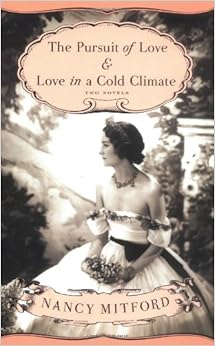
The Pursuit of Love: Fast, merry, and delightful. The entire story reads like a friend gossiping to you, without becoming trite in any way. Though it took place during wartime, the tone consistently stayed bright throughout, and delivered plenty of humor to keep me engaged as I sped through every sentence. The contrast between the narrator and Linda was just right, too, I think, and I really do think that Mitford is a very engaging storyteller. This is very much a woman's novel, and I could imagine it to be the equivalent of chick lit today in its day, but it's in no way a guilty read. The way it ended! Hilarious! "The doctors who said that Linda ought never to have another child were not such idiots after all. It killed her." Bam. She died. So to the point out of nowhere when the whole story was about her. So randomly brilliant, I'm still recovering.
Love in a Cold Climate: If Linda is a whirlwind, Polly is a stone. Unlike the Alconleighs, who were so personable and warm, the Montdores are distant and chilly. With The Pursuit of Love, I felt drawn in and included, whereas with Love in a Cold Climate I felt distant and a bit melancholy. It felt, too, a bit older (matured), like our eyes were opened to the truth whereas in Linda's story we were all (quite obviously) blinded by youth and romance. Mitford's wit was still there, and there were spells of humor from the first story that would occasionally peek out, winking at you, but altogether, the two are very different stories curiously spanning the same periods. With Lady Matdores' superficiality, however, Cold Climate felt a little more mainstream to stories of aristocracy, and therefore slightly less original.
The biggest mystery to me though, is why everyone loves Davey so much, and seriously, how isn't he gay?
A writer's conversations & response to the 1001 Books You Must Read Before You Die list.
Thursday, May 14, 2015
Saturday, May 2, 2015
Kafka on the Shore
Another Murakami. The most popular, as far as I'm concerned, but to me, the least satisfactory. The entire novel felt disconnected, like I was set on a treadmill at walking pace, without any goal in sight. At least in his previous novels there was some sort of goal to be worked after. As expected, the story quietly ended with no resolution or really any attempt at sense.
I'm not sure if this reaction is due to the fact that I've read so many of his books now and am tired of his style, or that Kafka really was a lackluster work. Sure, some of the characters were interesting and likable, but it was hard to care about anything happening at all. It feels more like I was introduced to them for a brief period, and now will forget them all without effort. And "The Boy Named Crow" was really just annoying, and made no sense to me. If you're going to personify the conscience, do it with purpose. I'd like to know what Murakami's intent in writing all of these stories are. Maybe he's like Miss Saeki in this story, writing for no one and no reason.
Per usual, the world of Murakami in Kafka was muted and quiet. Lack of feeling, but uneasy, like a surrealist painting. This feeling bleeds into real life when I read his writing, so now that it's spring, maybe I'm glad that I'm through with his books. At least for a while.
I'm not sure if this reaction is due to the fact that I've read so many of his books now and am tired of his style, or that Kafka really was a lackluster work. Sure, some of the characters were interesting and likable, but it was hard to care about anything happening at all. It feels more like I was introduced to them for a brief period, and now will forget them all without effort. And "The Boy Named Crow" was really just annoying, and made no sense to me. If you're going to personify the conscience, do it with purpose. I'd like to know what Murakami's intent in writing all of these stories are. Maybe he's like Miss Saeki in this story, writing for no one and no reason.
Per usual, the world of Murakami in Kafka was muted and quiet. Lack of feeling, but uneasy, like a surrealist painting. This feeling bleeds into real life when I read his writing, so now that it's spring, maybe I'm glad that I'm through with his books. At least for a while.
Sunday, April 12, 2015
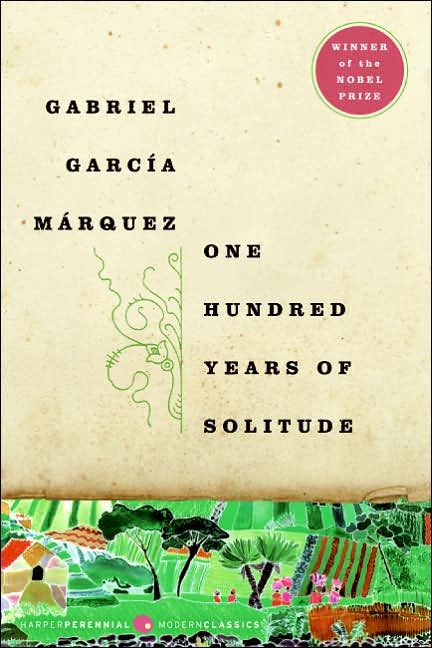
One Hundred Years of Solitude
Simultaneously light, heavy, magical, realistic, playful, melancholy, and impeccably thoughtful, One Hundred Years of Solitude by Gabriel Garcia Marquez is one that had me feeling things for a fictional family that is hard to believe is achievable. Somewhere between the story of however-many Buendia generations, I became part of the family...or maybe, one among many ghosts living in the house.
I am an absolute sucker for nostalgia and the way that Marquez treated this theme is remarkable. With the use of the same 4-5 set of names used over and over, he created an experience where one is not simply being told the story, but rather being forced to remember along with the rest of the characters. The events and emotions within the story become the reader's memories, and as the characters recall the past, so do you. I seriously grew nostalgic for deceased characters when they were mentioned at the end. I mean, come on.
There were, at times, moments where I became tired of the repetitious themes, as I'm sure is expected, but at the final turn of the page, I am left completely enchanted with every aspect of the little village of Macondo's (wherever it's supposed to be, because I'm still not sure) history and the people within it. I mean it; do not falter, just keep reading. It's the in kind of book that makes you want to live.
I am an absolute sucker for nostalgia and the way that Marquez treated this theme is remarkable. With the use of the same 4-5 set of names used over and over, he created an experience where one is not simply being told the story, but rather being forced to remember along with the rest of the characters. The events and emotions within the story become the reader's memories, and as the characters recall the past, so do you. I seriously grew nostalgic for deceased characters when they were mentioned at the end. I mean, come on.
There were, at times, moments where I became tired of the repetitious themes, as I'm sure is expected, but at the final turn of the page, I am left completely enchanted with every aspect of the little village of Macondo's (wherever it's supposed to be, because I'm still not sure) history and the people within it. I mean it; do not falter, just keep reading. It's the in kind of book that makes you want to live.
Saturday, March 14, 2015
Sputnik Sweetheart
More Murakami! There's another one to go, but don't worry, I'm going to take a break before I go on to that one.
I like Sputnik Sweetheart the most out of the three Haruki Murakami books I've read so far, I think. I'm not sure if it was because the translation was done by someone else (Philip Gabriel - the first two were by Jay Rubin), or if Murakami actually wrote in a different style relative to the personality of the characters, but this novel read in a much more welcoming, casual vibe. It's still surreal, but stays on topic more than his other works, with a clear plot and more importantly, the characters seem to have true feelings.
The fact that one of the main characters is a lesbian, too, gives a refreshing modern angle to the book. Even now, I don't think characters such as Sumire exist very often in culture in patriarchal Japan which made it all the more enjoyable to see a free-spirited, "hipster" girl amid the frigid, mechanical women of Murakami's usual worlds. This misfit quality gave her even more life, in a way that I don't think I would really have appreciated had I not read the author's other works beforehand.
The loneliness of existence seems to be a common theme in Murakami's works, but its clear that it isn't something he's trying to solve or explain. It feels more like he's simply inviting you into a friendly (mostly one-sided) conversation for a few minutes to gage your reaction. Maybe you'll quietly listen, or maybe even agree with him - I think that's what would give him the most pleasure.
I like Sputnik Sweetheart the most out of the three Haruki Murakami books I've read so far, I think. I'm not sure if it was because the translation was done by someone else (Philip Gabriel - the first two were by Jay Rubin), or if Murakami actually wrote in a different style relative to the personality of the characters, but this novel read in a much more welcoming, casual vibe. It's still surreal, but stays on topic more than his other works, with a clear plot and more importantly, the characters seem to have true feelings.
The fact that one of the main characters is a lesbian, too, gives a refreshing modern angle to the book. Even now, I don't think characters such as Sumire exist very often in culture in patriarchal Japan which made it all the more enjoyable to see a free-spirited, "hipster" girl amid the frigid, mechanical women of Murakami's usual worlds. This misfit quality gave her even more life, in a way that I don't think I would really have appreciated had I not read the author's other works beforehand.
The loneliness of existence seems to be a common theme in Murakami's works, but its clear that it isn't something he's trying to solve or explain. It feels more like he's simply inviting you into a friendly (mostly one-sided) conversation for a few minutes to gage your reaction. Maybe you'll quietly listen, or maybe even agree with him - I think that's what would give him the most pleasure.
Friday, March 6, 2015
After the Quake
After obsessing over The Wind-Up Bird Chronicle, I binge bought all of the Murakami titles on the 1001 list. As the books I've ordered trickle in, I started on After the Quake. It is a collection of 6 short stories with minor ties to the 1995 Kobe earthquake.
The first story, ufo in kushiro, was so similar to Wind-Up Bird that my initial reaction to the collection was a tired disappointment. However, as the other stories opened up, I was happy to see that Murakami does clearly have creativity beyond one story line and has a talent for evoking wonder with mysterious fantasy-like scenarios.
It's hard not to think of the Fukushima earthquake and tsunami in 2015 while reading about lives affected by a large scale disaster in Japan. You don't really think about how such an event affects people who are indirectly tied to it, and Murakami does this in a crafty way that makes you think. None of his characters have suffered the loss of a loved one by the earthquake, but all of their buried pasts are brought to the surface in haunting ways.
I think part of the strangeness in Murakami's writing is that all of his characters never seem fundamentally Japanese. Any references to brand names, literature, and culture is always reflective of Western culture. Even the food that they eat is European/American (why is it always spaghetti??). I'd be interested to read it in the original language to see if it translates differently, although unfortunately my skills with Japanese text are not so advanced.
In relation to that, one thing that bothers me is the use of the phrase "don't let it bother you too much" that gets used constantly in Jay Rubin's translations of the female characters in Murakami's books. I don't know what the original Japanese term was from which it came, but this particular choice of words bothers me. It seems to cold and unapologetic, something that I can't imagine creeping in to Japanese speech as often as it does in these stories. But then again, I guess women are cold enough in Murakami's world to constantly be disappearing/leaving in. I wonder if it reflects on his personal life.
The first story, ufo in kushiro, was so similar to Wind-Up Bird that my initial reaction to the collection was a tired disappointment. However, as the other stories opened up, I was happy to see that Murakami does clearly have creativity beyond one story line and has a talent for evoking wonder with mysterious fantasy-like scenarios.
It's hard not to think of the Fukushima earthquake and tsunami in 2015 while reading about lives affected by a large scale disaster in Japan. You don't really think about how such an event affects people who are indirectly tied to it, and Murakami does this in a crafty way that makes you think. None of his characters have suffered the loss of a loved one by the earthquake, but all of their buried pasts are brought to the surface in haunting ways.
I think part of the strangeness in Murakami's writing is that all of his characters never seem fundamentally Japanese. Any references to brand names, literature, and culture is always reflective of Western culture. Even the food that they eat is European/American (why is it always spaghetti??). I'd be interested to read it in the original language to see if it translates differently, although unfortunately my skills with Japanese text are not so advanced.
In relation to that, one thing that bothers me is the use of the phrase "don't let it bother you too much" that gets used constantly in Jay Rubin's translations of the female characters in Murakami's books. I don't know what the original Japanese term was from which it came, but this particular choice of words bothers me. It seems to cold and unapologetic, something that I can't imagine creeping in to Japanese speech as often as it does in these stories. But then again, I guess women are cold enough in Murakami's world to constantly be disappearing/leaving in. I wonder if it reflects on his personal life.
Wednesday, March 4, 2015
Mrs. Dalloway
I knew nothing about Virginia Woolf save the fame of her name a week ago, and I must admit, after reading what Google pointed to as the easiest to read for Woolf beginners; Mrs. Dalloway, I still don't have a clear understanding of what she's supposed to represent.
What to say? The novel is incredibly fluid, changing from one character's point of view to the next's with the theatrical style of a camera swinging in one seamless move. It's remarkable, really, as you hardly realize it's happening until it has, and your mind has to play catch-up.
The fact that the main characters are elderly came as a shock to me as well. It so rarely happens, and even less so when it relates to the bourgeois and events like fancy dinner parties. I must say the fact that my book's cover had a photograph of ladies in their twenties did not help the matter.
I enjoyed the moments shared between Peter and Sally best. And though I cannot say I was especially pulled by the novel as a whole, the final section was provoking. I like the draw of the past, and the reality of emotions vs. rationality in fiction because one cannot really experience that of other people in real life. Life choices...am I right?
What to say? The novel is incredibly fluid, changing from one character's point of view to the next's with the theatrical style of a camera swinging in one seamless move. It's remarkable, really, as you hardly realize it's happening until it has, and your mind has to play catch-up.
The fact that the main characters are elderly came as a shock to me as well. It so rarely happens, and even less so when it relates to the bourgeois and events like fancy dinner parties. I must say the fact that my book's cover had a photograph of ladies in their twenties did not help the matter.
I enjoyed the moments shared between Peter and Sally best. And though I cannot say I was especially pulled by the novel as a whole, the final section was provoking. I like the draw of the past, and the reality of emotions vs. rationality in fiction because one cannot really experience that of other people in real life. Life choices...am I right?
Thursday, February 26, 2015
The Wind-Up Bird Chronicle
I have been avoiding Murakami for the past 6-7 years now, ever since I noticed it becoming so prominently featured in American bookstores for that simple fact alone. Having finally read one now, I can honestly say that the decision I had been making was a stupid one.
It has been a very long time since I have been so engaged in a book. I felt sincerely sorry as the pages in my right hand grew fewer in number, but yet propelled to continue further and to let the story continue. Simply speaking, I loved the experience I had with this book. So much so, that although I have other books to start ready to go, I may just go to the book store and buy more Murakami novels in order to feed this new passion that has been lit within me.
The Wind-Up Bird Chronicle is surreal in a way that stands out from other stories that might be compared to it. Murakami is able to manipulate emotion in a way that I have rarely experienced before in reading: there are parts that are incredibly graphic and grotesque, yet simultaneously warmly enveloping. In the same way, there are other parts that are beautifully poetic yet cause an emotional discomfort that is hard to describe.
Almost all of Murakami's characters are chatty. This is another unusual way in which the author builds the novel. We learn the stories of each character from their own words, simply because they all tend to overshare while getting to the point of something completely off-topic. As far as I'm concerned, I have never experienced a writing style like this before, and as a writer who struggles with dialogue, I admire it.
My only regret is that the story did not end with a clear wrap-up of the countless number of loose threads presented throughout the book. In the end, Murakami chose not to approach reason, but somehow it did not offend me in the way that other books do when they leave plot holes unfilled. Like the tentacles of the jellyfish that Toru Okada so feared, all of the questions I had built up remained gently swaying in the dark with ominous mystery. Somehow, though, it just worked.
It has been a very long time since I have been so engaged in a book. I felt sincerely sorry as the pages in my right hand grew fewer in number, but yet propelled to continue further and to let the story continue. Simply speaking, I loved the experience I had with this book. So much so, that although I have other books to start ready to go, I may just go to the book store and buy more Murakami novels in order to feed this new passion that has been lit within me.
The Wind-Up Bird Chronicle is surreal in a way that stands out from other stories that might be compared to it. Murakami is able to manipulate emotion in a way that I have rarely experienced before in reading: there are parts that are incredibly graphic and grotesque, yet simultaneously warmly enveloping. In the same way, there are other parts that are beautifully poetic yet cause an emotional discomfort that is hard to describe.
Almost all of Murakami's characters are chatty. This is another unusual way in which the author builds the novel. We learn the stories of each character from their own words, simply because they all tend to overshare while getting to the point of something completely off-topic. As far as I'm concerned, I have never experienced a writing style like this before, and as a writer who struggles with dialogue, I admire it.
My only regret is that the story did not end with a clear wrap-up of the countless number of loose threads presented throughout the book. In the end, Murakami chose not to approach reason, but somehow it did not offend me in the way that other books do when they leave plot holes unfilled. Like the tentacles of the jellyfish that Toru Okada so feared, all of the questions I had built up remained gently swaying in the dark with ominous mystery. Somehow, though, it just worked.
Subscribe to:
Posts (Atom)