Graham Greene's The End of the Affair is only 160 pages, yet manages to pack in such complexity and believable emotion that it makes me wonder if the author actually lived through some failed affair himself.
Though the main character, Bendrix, describes his story as one of hate, every action is so steeped in love that it's incredibly easy to relate. He and his situation become so real that it's like reading someone close's diary while he in turn is reading someone else's (at times. See, it's like intricate weaving). His relationship to God too, is something I can relate to. And it's not only him but to every character presented that you get attached to. Everyone is so tragic and real and likable, which I honestly wasn't expecting. It's a timeless yet modern work that's definitely worth a try.
From a more current reading list, I've also recently finished reading The Starless Sea by Erin Morgenstern. I'd never read her previous book, but after seeing a random review of this new one, I was interested and bought it immediately. It's a fairy tale for adults, and Morgenstern creates gorgeous imagery with skill, without losing control of the plot. Her style reminded me of my writing in college, so it was definitely up my alley. It was a change of pace to read something that leant more on the entertaining side without having to stretch my brain—the pages flew by and I enjoyed it all the way.
A writer's conversations & response to the 1001 Books You Must Read Before You Die list.
Sunday, December 29, 2019
Saturday, November 2, 2019
Stranger in a Strange Land
#444, Stranger in a Strange Land by Robert A. Heinlein is a mixed bag. I enjoyed it, though the cult aspect of it toward the end got a bit creepy, which I guess it was meant to be. I'm trapped in a loop of mental conflict when it comes to deciphering Heinlein's message, though. Is the narrative telling me that society requires something/someone to follow and believe in, or that rather people are easily brainwashed by those that seem to perform miracles? Or, is it that there is no true right or wrong and that society's morals are fallacies....or further yet is it that people can be so easily manipulated to do wrong as long as there is a convincing figurehead telling them to do so? Maybe it's all these things. Maybe it's just about the shortcomings of humanity as a whole.
My biggest gripe is with Jill, who started off as such a strong, smart persona but just ended up turning into an opinion-less sex object after she basically gets bewitched by Mike. The same goes for the rest of Jubal's lady friends. Is that Heinlein's idea of women faced with men of power? Maybe it's just a result of the difference between the times, but it's still disappointing.
Not being a fan of religion myself, however, I kind of liked it that the crazy Fosterites ended up being legit. A light touch of comedy there in the end.
Also can someone tell me what the big thing about whoever Dorcas' kid's father is? Is it not Mike??? WHO IS IT AND WHY IS IT SUCH A BIG DEAL?
My biggest gripe is with Jill, who started off as such a strong, smart persona but just ended up turning into an opinion-less sex object after she basically gets bewitched by Mike. The same goes for the rest of Jubal's lady friends. Is that Heinlein's idea of women faced with men of power? Maybe it's just a result of the difference between the times, but it's still disappointing.
Not being a fan of religion myself, however, I kind of liked it that the crazy Fosterites ended up being legit. A light touch of comedy there in the end.
Also can someone tell me what the big thing about whoever Dorcas' kid's father is? Is it not Mike??? WHO IS IT AND WHY IS IT SUCH A BIG DEAL?
Thursday, September 12, 2019
The Years
There's a lot of things that made me stop and think (or maybe, more accurately, pause on the realization that I had such a thought while I was still reading) about Virginia Woolf's The Years that didn't have much to do with an overarching plot line. In truth, there were so many characters presented in this book that it was hard for me to keep track of them all, and because only a few of them stood out for me enough to be remembered, I simply just allowed myself to drift along without a clear idea of who anyone was at any given time but rather just delve on the individual moment presented and the feelings that were felt.This is my second experience with the late Mrs. Woolf's works, and what I'm discovering is that she is showing the world that the aging female character is a person, and that's she's just as capable—if not more so—of being an interesting and textured lead character than any of her younger counterparts (though I guess no one was really a lead in this book). She doesn't always need to be restricted to a passing name or supporting role, and it's a strange thing to think about how even in 2019, it's not something you come across much.
There was a lot of repetition in this book that I couldn't quite crack the meaning of. Almost every character at some point repeats a line that they've spoken several times, often back to back. It's unsettling and strange but there must be a reason for it. Maybe it ties in to the idea that life is just a series of repetitions, as one of the characters notices at some point. The ending certainly supports that feeling—it's a pretty and hopeful one, encapsulating life lived as a memory and the eternity of youth within one's mindset.
Thursday, July 4, 2019
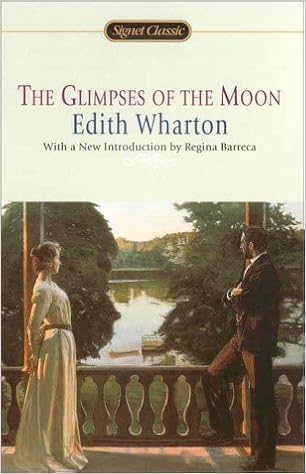
Glimpses of the Moon
Edith Wharton's Glimpses of the Moon is simple, easygoing, and very likable. Susy and Nick are intelligent characters with agreeable qualities, and following them through the pages on their months of joyriding is as pleasant as if you were there along with him. The only problem in the entire story is the irrationality of indecision that one experiences when in love, which pretty much illustrates the vanilla quality of this book.
What is it like, to live in a world where you can just completely live off of the wealth of your friends, I wonder. And even the rich, who seem to enjoy their days spending extravagantly without lifting a hand to work. I see it so often in books based in the past, and have a hard time wrapping my mind around it. Is this real? Do people like this still somehow exist in this world? How!?
I suppose it's supposed to be valiant that the couple chooses real love over material wealth, and that Susy at least seems to understand what it takes to survive in the world through her own efforts...but I'm not sure Nick does, or even appreciates what Susy has done. I hope he learns to pull his weight too, rather than spending his days dreaming and criticizing others'. I mean, really. How like a man.
What is it like, to live in a world where you can just completely live off of the wealth of your friends, I wonder. And even the rich, who seem to enjoy their days spending extravagantly without lifting a hand to work. I see it so often in books based in the past, and have a hard time wrapping my mind around it. Is this real? Do people like this still somehow exist in this world? How!?
I suppose it's supposed to be valiant that the couple chooses real love over material wealth, and that Susy at least seems to understand what it takes to survive in the world through her own efforts...but I'm not sure Nick does, or even appreciates what Susy has done. I hope he learns to pull his weight too, rather than spending his days dreaming and criticizing others'. I mean, really. How like a man.
Friday, May 24, 2019
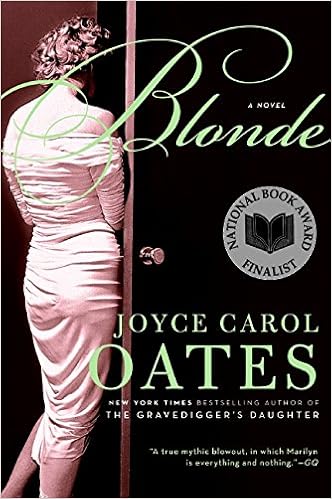
Blonde
It's curious to me why someone would write a book like Blonde by Joyce Carol Oates—fiction, altering the facts of history on a real person who already led such a storied life. While reading this book, I often thought that I would prefer to read the real facts rather than getting led astray by Oates. I love the author's Marilyn and I'd like the real woman to have been as she is described, but I can't be sure due to the nature of this work and that bothers me, a bit. Still, remembering the surprise I felt when I first experienced her films (she's not a sexpot bimbo, she plays a woman, believably, and sparkling with life), I can believe that she was something along the lines of the intelligent, sweet, genuine person that's characterized here.
This excerpt, which I love, sort of reflects real life vs the facade of entertainment, which I find relevant—though not exactly matching my point. Mainly, I just wanted to share it/write it down and was trying to figure out a way to work that in:
"The playwright would think how, in a play, such an accusation would have a ring of truth to it. Even as the accusation was strenuously denied, the audience would understand. Yes, it's so.
Yet in actual life the strategies of drama were not applicable. In the extremities of emotion, terrible things were said that were not true and were not meant to be true, only just the expression of hurt, anger, confusion, fear; fleeting emotions, not obdurate truths. (p 578)"
Google taught me that Marilyn did in fact write poetry, but it's not clear to me whether it was actually her words incorporated into the pages or whether those were Oates' interpretations. They were sensitive, well-written pieces, which leads me to believe they are fictionalized, but I wish that weren't so.
Anyway, the final page was beautiful and I'm getting a kick out of being introduced to female writers I've never read before. I think I'll keep up with that trend for now.
This excerpt, which I love, sort of reflects real life vs the facade of entertainment, which I find relevant—though not exactly matching my point. Mainly, I just wanted to share it/write it down and was trying to figure out a way to work that in:
"The playwright would think how, in a play, such an accusation would have a ring of truth to it. Even as the accusation was strenuously denied, the audience would understand. Yes, it's so.
Yet in actual life the strategies of drama were not applicable. In the extremities of emotion, terrible things were said that were not true and were not meant to be true, only just the expression of hurt, anger, confusion, fear; fleeting emotions, not obdurate truths. (p 578)"
Google taught me that Marilyn did in fact write poetry, but it's not clear to me whether it was actually her words incorporated into the pages or whether those were Oates' interpretations. They were sensitive, well-written pieces, which leads me to believe they are fictionalized, but I wish that weren't so.
Anyway, the final page was beautiful and I'm getting a kick out of being introduced to female writers I've never read before. I think I'll keep up with that trend for now.
Saturday, April 6, 2019
Sabbath's Theater
Sabbath's Theater is definitely not my favorite Roth. It's dark, dirty, tragic and sometimes hard to read through the gritty sex-driven plot which lacks the elegance I've enjoyed in his other novels. Yet it's still smart, human, and the writing is engaging, a far more enjoyable experience than I've had with other books that have had just as distasteful topics.
To a point, you hope that Sabbath will pull through and become a better person, but over and over again he slips until his failures become irredeemable and impossible to forgive. After so many pages piling on account after account of his predatory nature, I started to feel creeped out and uncomfortable. Basically, only in his moments with Drenka is he ever really likable. He's capable of being kind, charming, and even loving, and I guess that's what makes him even more disgusting when he acquieces to his vile urges.
Speaking of Drenka, the people around him are always so good in contrast. Not just her, but Norman, Fish, Morty, Matthew and even Katie. Despite being surrounded by their support and love, Sabbath still cannot become a model citizen. I suppose it's a comment on human nature and the expectations of society.
I wouldn't read this again, but I don't regret it, either. On to the next.
To a point, you hope that Sabbath will pull through and become a better person, but over and over again he slips until his failures become irredeemable and impossible to forgive. After so many pages piling on account after account of his predatory nature, I started to feel creeped out and uncomfortable. Basically, only in his moments with Drenka is he ever really likable. He's capable of being kind, charming, and even loving, and I guess that's what makes him even more disgusting when he acquieces to his vile urges.
Speaking of Drenka, the people around him are always so good in contrast. Not just her, but Norman, Fish, Morty, Matthew and even Katie. Despite being surrounded by their support and love, Sabbath still cannot become a model citizen. I suppose it's a comment on human nature and the expectations of society.
I wouldn't read this again, but I don't regret it, either. On to the next.
Saturday, March 2, 2019
Naked Lunch
You guys, I just can't do this one. I got to page 12 and called it quits. The moment I saw Kerouac's name mentioned in the prologue, I knew it was going to be tough, but even The Road I was able to suffer through to the last page. But this one—William Burroughs' Naked Lunch—is gonna be a solid no from me.
Which brings me to my first breakthrough decision about this 1001 list. There are just going to be some books that I can't stand to bear and will henceforth feel okay giving up on trying to finish. Lunch is the first work that I have officially marked as "abandoned". I already know that Finnegan's Wake will probably also follow in Lunch's footsteps from what I have read/heard from it so far, but up until this point I had every intention of trying again someday.
Anyway, here's what I gathered from 12 pages + prologue:
It's a work based entirely on drug addiction, and was written by the author while he was suffering from this "disease". Naturally, this subject matter makes the tone gritty, but the additional nonsensical beatnik quality is exactly the type of prose that I absolutely cannot enjoy. There is no storyline and I swear to god I did not get any meaning out of any of the words that were being put into my brain within any of the pages I read after the prologue. Clearly, this was a complete waste of time for me, which is why I have chosen to stop.
So back to Half Price Books this book goes...but, I'm feeling good about this new development in identifying things that I dislike enough to give up on.
Current stats on my progress:
Finished/read: 162/1001
Abandoned: 1
Which brings me to my first breakthrough decision about this 1001 list. There are just going to be some books that I can't stand to bear and will henceforth feel okay giving up on trying to finish. Lunch is the first work that I have officially marked as "abandoned". I already know that Finnegan's Wake will probably also follow in Lunch's footsteps from what I have read/heard from it so far, but up until this point I had every intention of trying again someday.
Anyway, here's what I gathered from 12 pages + prologue:
It's a work based entirely on drug addiction, and was written by the author while he was suffering from this "disease". Naturally, this subject matter makes the tone gritty, but the additional nonsensical beatnik quality is exactly the type of prose that I absolutely cannot enjoy. There is no storyline and I swear to god I did not get any meaning out of any of the words that were being put into my brain within any of the pages I read after the prologue. Clearly, this was a complete waste of time for me, which is why I have chosen to stop.
So back to Half Price Books this book goes...but, I'm feeling good about this new development in identifying things that I dislike enough to give up on.
Current stats on my progress:
Finished/read: 162/1001
Abandoned: 1
Subscribe to:
Posts (Atom)